
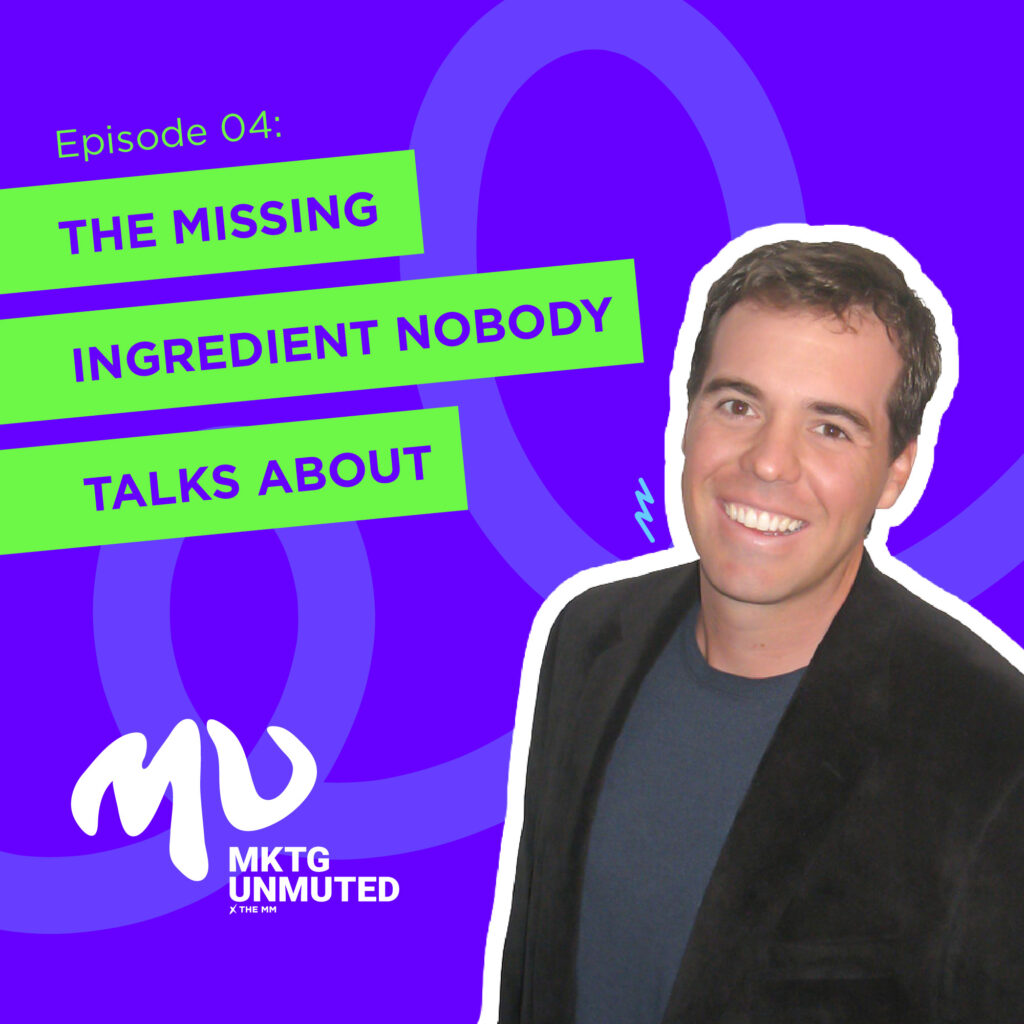
We’re joined by Coach Troy with EVOC Excellence to talk about what actually makes marketing work; from knowing when to outsource (and when not to), to understanding what stage your business is in and making smarter decisions along the way.
Plus, the “pinch of salt” philosophy, marketing pitfalls, data, and why you should always be the master of your own marketing. 👀
Connect with Coach Troy on LinkedIn Here
Chapters
- 00:00 The Supportive Coach
- 01:21 The Pinch of Salt
- 03:08 Mindset Shifts
- 06:51 Hiring and Pitfalls
- 09:33 Business Growth Phases
- 11:03 Agency Pitfalls
- 15:07 Data-Driven Marketing
- 19:51 The Pitfalls of Offloading Marketing
- 24:08 Clarity in Business and Marketing
- 27:15 Strategic vs. Tactical Marketing
- 29:09 Brand Development and Revenue Stage
- 31:02 Building Brand and Proving Concepts
- 34:25 Matching Stage with Resources
Episode Transcript:
Brennah Davis (00:08)
Hi, Coach Troy. I’m so excited for you to be a part of MKTG Unmuted. I know that you have been a huge supporter with me and all the things that I’ve been doing. And I’m super pumped to have you on here. You are Coach Troy to me. You own EVOC Excellence. And one of the major things that I’ve appreciated working with you, getting to know you, is how much you support businesses.
As a coach, with the mental mind shift that we have to make as entrepreneurs, and in many aspects, I mean, especially in marketing too, but part of the reason I wanted to be on here is because I’ve experienced so much growth with myself in marketing just working with you. Yeah.
Coach Troy (00:54)
Cool. That’s awesome.
Yeah. Well we’ve had a lot of good conversations over the past year, I think. I’ve been taught.
Brennah Davis (00:58)
Yeah, we have.
Yeah, we have. Especially with the executive roundtable, which, you know, I love doing and hearing all these people’s stories and Yeah. So
Coach Troy (01:07)
Yeah.
Brennah Davis (01:08)
one of the things I remember and I’ll just bring this up is I remember one of the days that y you and I were talking about just even my marketing and you’re like, Brennah, you know, have you ever baked
Brownies. Was that was it brownies? You’re like, have you ever baked brownies?
Coach Troy (01:24)
I think it was chocolate cake.
Brennah Davis (01:26)
it was a chocolate cake. Okay, it was chocolate cake. You’re like, Have you ever made chocolate cake? And I was like, Yeah. I’ll let you tell it ’cause you tell it way better than I do.
Coach Troy (01:32)
you’re talking about the pinch of salt. Yeah.
Brennah Davis (01:34)
Yes.
Coach Troy (01:36)
I always I remember when I was a kid and I would mess around with my mom or my grandma in the kitchen and you know, they’d be making cake and that I would look at the recipe. and they’d tell me to do certain things and it was kind of part of my job to do the little things, right? So they’d say, Okay, now we need a pinch of salt. You put a pinch of salt in. And I don’t know why that stuck with me forever, but there was always this pinch of salt that goes into the recipe. So you got
X pounds of sugar or cups of sugar and flour and chocolate chips and all that stuff, but then it’s just a pinch of salt. I never really thought about it until I got older, and then I realized that’s kind of how marketing works. You know, there’s this formula that we follow, or I think we should follow. We should build a plan. That plan should have steps, we should follow those steps, but there’s
Parts of that that I think are parallel, the pinch of salt. It’s like, how much is a pinch of salt? I don’t know, it’s a pinch. What’s the point of the pinch of salt? I don’t know exactly, but my grandma says it’s because of that that makes it moist. You know? It’s
Brennah Davis (02:35)
Mm.
Coach Troy (02:35)
that little thing that we don’t know exactly why we do it or how we do it, but we know if it’s not there, it doesn’t come out right.
And everyone has their own kind of version of the pinch of salt. And my grandmother’s recipe that my mom used, it had a pinch of salt. And I think that’s what one of the secrets in marketing is like what is gonna be your pinch of salt? Like how do you know what the pinch of salt is? How do we know what that little thing is? And you and I were talking one of our last conversations about going viral, you know, and what makes something go viral.
I don’t know, maybe you know. I think of it as just there’s a pinch of salt somewhere, right? somebody throws in their own little thing into something like a hundred people could do the same video or topic or funny little skit and nothing. But then somebody does something, it’s got that little pinch of salt in it, and it just goes viral. And how do you know what that is? I don’t know. But I don’t think we can leave out the little things you know. we have to kind of figure out what it is that we do
And that’s the way I think about it. I don’t know if you thought about it differently, but that’s how I think about it.
Brennah Davis (03:38)
I’ve have it right here. This is my pinch of salt. and I keep it on my desk because it to me it represents what is that pinch of salt. what are you putting in that is different than everyone else? That’s kind of how I see it, right? If we all have the same exact recipe.
And we’re all making the same cake, Like I think about it even with cookies, right? If you were to make chocolate chip cookies, and there’s a place in Phoenix that every time I buy the cookies, I’m like, these cookies are so good. And you know what’s on it?
Coach Troy (04:07)
Yeah.
Brennah Davis (04:08)
Sprinkle of salt.
that cookie is so much better because
Coach Troy (04:12)
Yeah.
Brennah Davis (04:13)
of the melted chocolate and the dash of salt, the pinch of salt. And so
Coach Troy (04:16)
Yeah. Yeah.
Brennah Davis (04:18)
To me it’s that, like what makes your situation elevated? What makes your situation, your business, your type of marketing, how do you have your pinch of salt that makes you different than everyone else?
Coach Troy (04:31)
Yeah. that little added flavor. Your little secret sauce. Yeah. Yeah.
Brennah Davis (04:34)
Yeah.
So I’ve kept that on my desk So I have my pinch of salt reminding me all the time.
Coach Troy (04:42)
That’s really cool.
It’s really cool. I love those little nuggets that everyone has them. I’ve got a dashboard I use every week to manage my week. It’s an Excel sheet. I’ve tried to migrate off it and use a bunch of other things and I always come back to that. But at the top of that, I’ve got like these lines, like the first ten lines. I’ve just put in all these, it’s like my little dashboard of post-it notes.
You know, it’s like pinch of
Brennah Davis (05:05)
Okay.
Coach Troy (05:06)
salt and all all this different stuff think I think that’s part of the secret, you know, some secrets to success. You know, every really successful person I know, they’ve got their little touchstone idioms and mindsets and focus and strategy little things. so it’s really cool. it’s fun to hear what people’s are. I think that would be a really cool kind of I don’t know if it would be a podcast for like a
Just something to do with people and ask like what are your little pinch of salt nuggets
Brennah Davis (05:33)
Mm-hmm.
Coach Troy (05:34)
that keep you going throughout the day, that keep your business going, that keep your focus going? I think it’ll be interesting to hear from a bunch of people.
Brennah Davis (05:40)
Yeah, because everyone
has their thing. you are a sponsor to EOA, which I’m a part of EOA. and part of being in EOA is you get to hear all of these different businesses’ stories and the things that motivate them. And I can’t share all the things I know because we have confidentiality, but
It’s just so cool to hear what motivates businesses and how they started and where they are now and what motivates them to through the hard stuff today. And part of
Coach Troy (06:11)
Yeah.
Brennah Davis (06:11)
my hard time, I’d say, was that pinch of salt moment for me. So being able to like have that there and just remind myself like, you know, it’s just a pinch of salt. It’s just a pinch of salt.
Like, it’s all it is. But what is it?
Coach Troy (06:26)
But is it just a pinch?
Brennah Davis (06:28)
It is just a pinch of salt.
Coach Troy (06:29)
Yeah, yeah, simple.
Brennah Davis (06:30)
And so
yeah, I know that you and I have worked on this executive roundtable and we’ve been exploring a lot of conversations about marketing it’s not even in marketing that we see the same things happening, right? It can be in any role of a business. Like one of the things that you and I have talked a lot about is hiring a technician versus
an executive and how that’s affecting businesses. But one of the main things that I really love talking to you about is that mind shift that has to be happening as owners as we grow.
Coach Troy (07:02)
Yeah.
Brennah Davis (07:03)
it’s all parts of business and life that we have to realign ourselves.
Coach Troy (07:07)
Yeah, I call
them like evolutions. Like as we go from one phase of our life, whatever it is. I mean, I remember going through it playing, you know, I played a lot of sports, that’s kinda how I got into coaching, but I remember playing tennis and then I got into playing a lot of golf when I was a little bit older. I can specifically tell you, and even when I started my business, my coaching business, I can tell you specifically the mindset shifts, like the evolutionary shifts that I went through. They were very very specific.
You know, like when I started coaching, you know, the first thing I was doing was the mindset was learn how to coach, learn what it is and what you do and how you do it and how you talk to people and how you ask questions and you know how all these things that you had to do. And honestly one of the biggest things I had to do in in my evolution through that of learning how to do it, but one of the biggest mindset shifts I had to make was how to get myself out of the way.
Right. That was
Brennah Davis (07:56)
Mm.
Coach Troy (07:57)
one of my key mindset shifts just in building my business. I went through that and I got through that, and then came the next evolution. I was no longer worried about that piece so much. Didn’t go away, but I didn’t have to think about it as much. I didn’t have to process it as much. I’d kind of handled it. But then I got to the next next phase. And in the next phase, I had a whole different mindset that I had to think about and work through. And it included
the skills that I was learning and the the tools and the processes I was building and the type of clients I was working with. And I had to think about it differently. And I translate that to business owners that like when we’re entrepreneurs and we start our business, we have to think about building the business a certain way. And for most of us, it’s a very bootstrapped style of growth. You know, we are the primary driver
Most entrepreneur business owners, especially their small business owners that have never done it before, it’s their idea. they build a process, they put in their special sauce, their pinch of salt to whatever it is that they’re doing. And then they have to go out into the community and and sell it and get it, get some sort of traction with it. And so that becomes the
kind of the first driving force of the business. Well, once that happens and it gets going, we start making a couple hundred thousand dollars and and re start making some revenue, then the thousands of revenue, then hundreds of thousands of revenue, pretty soon that mindset kind of shifts. and I’ve been able to pinpoint some specific shifting points of things that need to shift. You know, once you go from zero to about two hundred and fifty thousand, that’s one one particular
approach and mindset approach you have to have. Once you go from 250,000 and you’re pushing up to say like a million. You know, that’s a completely different mindset approach. Once you go over a million, then there’s a whole different mindset of approach. And these are the things that I think we don’t realize. I mean I didn’t realize it until I started talking to hundreds and hundreds of people over 26 years now that there are these specific shifts. And
I think the hard part, right? the part that I see sticks people the most is that we’ve moved from this phase of the business to this phase of the business, yet we keep using the strategies, tactics, and mindset from this phase of the business to solve this phase. You know, and we can
Brennah Davis (10:13)
Yeah.
Coach Troy (10:13)
translate it directly into marketing. marketing at first is, you got to kind of create your
unique selling position and you’ve got to create kind of your brand, your brand identity. these are some of the basic fundamentals. But then as you move to the next phase, there’s a whole different, now I’ve got those pieces in place and now I’ve got to think about it differently. And
one of the big things I think you and I have talked about before is now we get to this point where I realize I’m not the master. I’m not the marketing guru.
it’s outside of my scope. I mean, I’ve done the best that I can and I need help. And so then probably I go to somebody like you and I say, hey Brennah, I need help and I don’t know where to go and I don’t know who to talk to, but there are some definite pitfalls and I might have stepped into a few of them. You and I have talked about them. one of them could be like hiring an agency. It is a big deal, but
It’s like, well, I’m just thinking, okay, I need some branding, I need some marketing, I need lead generation, I need all these things. I just think of it as marketing, so I’m gonna go hire an agency. Next thing I know, I’m spending five, ten, fifteen, twenty-five thousand, thirty thousand dollars a month. And gosh, I’ve talked to dozens of people who start doing that and they kind of set it, they try to set it, hire the marketing agency and then forget it. And then they’re like, now I’m off to go do other things and go, drink margaritas on the beach or try to work on some other
pet project in the business because I’ve hired a marketing agency. I’m spending X thousands of dollars a month, six, nine, eighteen months later, I don’t have what I want. I’m
Brennah Davis (11:37)
Yeah.
Coach Troy (11:37)
not getting the leads. I’m not getting the the closed business and I’ve just spent all this money. and that’s a pitfall. And that is a mindset pitfall as well as a strategic pitfall. Right? Yep.
Brennah Davis (11:46)
Yeah, a hundred percent. Because you hired
an agency that you just handed everything off
to and was like, take this ball and run. Meanwhile, the agency probably has reached out, like, hey, can we meet? And you’re like, I’m really busy, I’m focused on this. Like, you just do you, right? I’m just so busy.
and then months later, the owners come back, business owners come back to agencies and they’re like, Why isn’t this working? we asked for like
A dozen meetings to find out, like, hey, we’ve sent you 12 leads. Are these good leads? Are those bad leads? Why are they bad leads? What makes them a bad lead? what makes it a good lead? just trying to gather that data to be able to do better. But if they don’t get that data and they’re just like still running, it’s a problem.
I literally just had a friend who hired an SEO company. The SEO company’s been doing SEO for two years and she never managed them. Ever. And then she’s
like, Well, it’s not working. It’s like,
when’s the last time you met them? She’s like,
I don’t know, like six months ago.
Coach Troy (12:41)
Yeah. Yeah. I hear that all the time. You know, whether it’s in marketing or whether it’s hiring people I’m not gonna hire anybody for that position. I’m just gonna do it. I’m like, why not? Well, I’ve already tried. I’ve already hired like four, three, four, five people for that position. They didn’t work out. it’s just easier if I do it myself. And I remember having this a conversation with one of my clients. I told him, You’ve hired three or four people for that position and it didn’t work out. He goes, Yeah.
And I said, Well, first off, like he was a basketball player. And I said, You know, if you shot four free throws and you didn’t make them, would you just say that it’s impossible to shoot free throws and it wasn’t gonna work anymore? or what would you do? He goes, No, I’d probably go work on my technique and my skills and all these different things that I could do to become better at doing that. And I said, Okay, well, how many free throws would you have to shoot before you got good at it? He goes, Thousands.
I said, so you’ve basically shot three free throws relative to your hiring. You’ve hired three people, maybe four. You’ve done it three times, and now you’re saying, you know, this isn’t possible. It’s not good. There’s nobody good for this role. Like, how about give it another twenty tries and then tell me what you’ve learned? Not that it’s possible or not possible. And he goes, I have to hire twenty people? Like, maybe.
My guess is you probably won’t get to 20. You’ll probably find somebody good within those 20, but you’re thinking you should get a good hire within the first two or three. I mean, that’s just the wrong mindset. You know, out of all the people I’ve talked to over the years, the number of people that have been hired, just in every client that I’ve ever talked to, then do you think the number of people that have been hired versus the number of people that actually stick and do a great job? Which number is higher? Right?
there’s a thousand hires per one or two good people, across the board and everything. Yet we think that that’s just the wrong mindset, you know?
Brennah Davis (14:18)
I’m
like thinking about how like even just recruiting and hiring in general, like people sometimes, they do a really
good job at pitching, they pitch themselves so well. The agencies pitch themselves so well. And
and sometimes it’s not just the owner’s fault, that they did a bad hire, but sometimes it’s the agencies in a way that they’ve pitched so well, but they don’t deliver. And how is that business supposed to know?
That
that agency just, has a sales guy running that pitch and he’s so good and he overdelivers all this stuff and then they don’t actually produce. Yeah. And so
Coach Troy (14:53)
They don’t follow through very well, yeah. Yeah.
Brennah Davis (14:56)
that’s part of the reason I started what I did is because I hate those horror stories. I hate hearing the horror stories of marketing and how many bad agencies there are.
I know that there are bad agencies and I try really hard to filter them out.
Coach Troy (15:10)
Yeah. Yeah.
Brennah Davis (15:11)
I’ve only had one so far bad match in the sense that the agency said that they were gonna deliver something and I had done a really good, thorough background, had references, referrals for this agency, and what they produced was not at all what was expected. And I felt awful. But it was lots of lessons learned on my part. Like what fell through the cracks, what I missed right?
Coach Troy (15:34)
here’s a question for you, and I say we popcorn this back and forth.
If you had to come up with one way that you wished your clients would think versus the way that they do think, what do you think is one nugget of how they should approach their marketing?
If you’re like if I had the perfect client, they come in, they think like this.
Brennah Davis (15:51)
Say one thing I wish every client came in with is data, right? The data to say, I have tried this, and here was the outcome. I’ve tried this, here was the outcome, you know, because I think that there is a
idea in their mind that like, my competitor is doing this and it works. I need to do that. But it’s like you have no data. How do you know it’s working?
Coach Troy (16:14)
So you
want them to be thinking that I need to track my actions and my results?
Brennah Davis (16:20)
Yeah, so like not saying do those things and find out, but like based on what you’ve already done, what’s worked and what hasn’t worked. What have you tried? What have you not tried? Having that data and hey, I’ve sent 20,000 mailers and I got this many clients and this is how much it cost and this was the ROI it was this, and then
I wanna lower that cost per lead.
Coach Troy (16:40)
Yeah. And I think when people are tracking the data, like they say, numbers don’t lie. And I think it’s really easy to think one thing is happening without tracking it. It seems like this is the best thing, or it seems like that’s the best thing. I think about it with my golf. I might have told you the story at one point, but I was trying to get better at playing golf and like you’re playing golf, you try to hit the fairway. so you hit a tee shot, and my tee shot traditionally goes off to the right.
so I started tracking my data of where I missed I just keep a little log as I go, was it left, was it center, or was it right? Okay. And so I know traditionally I missed the ball more to the right. And so at one point I was like, okay, I gotta get better at hitting the ball down in the middle of the fairway. I went and I looked at all the data.
I have a little app that I use and it gave me the numbers and it showed me where my misses were. the sixty-eight percent of my misses were to the left.
Now, I just told you that I missed to the right. But ever since I was tracking the data, the data shows I missed 68% of my misses are to the left. another percentage are to the other to the right. That was surprising to me. If you would have asked me, where do I miss the most? Literally I just said it, I missed to the right. But the data showed me I missed to the left.
It was really weird. It was really eye-opening. I learned something else about it then, too, because this is where data is kind of cool. Is I realized that because I know I miss to the right, I constantly try to counter that to make sure I don’t miss to the right, which means I now miss to the left more than I miss to the right. I’ve corrected my error. So
It was funny because I was like, I missed sixty eight percent of left. I guess I don’t need to worry about missing right anymore. I’ll worry about not missing left anymore and I’ll start making that adjustment. My right misses went up dramatically.
So I realized in that game, which is interesting, that if I don’t worry about missing right, I will miss right a lot more. If I do
Brennah Davis (18:30)
Yeah.
Coach Troy (18:31)
miss worry about missing right, I miss left more. Data said it. So anyway, I think that’s really cool. I think people can
get lost in the way that they think things are in the business
versus what the data is.
Brennah Davis (18:43)
Yeah, I had a client back in the day, so it’s like years ago, but he was so adamant of getting this billboard on this one road. he was like, No, no, no, this is the busiest road. You know, I want my billboard right there. And he’s like, everyone will see it. That everyone was him. It was an ego thing And he wanted to see his
billboard every day because that was the road that he went on.
And he was like, Well, there’s always traffic, everyone drives on it. But it was like there’s zero data to any of what he was saying. And like we end up putting a billboard and they didn’t get that many calls. And it was just so frustrating.
Coach Troy (19:22)
Yeah.
Yeah. we come up with ideas. We think they’re good ideas and sometimes they are, but we gotta try stuff. Okay, so
Brennah Davis (19:29)
Yeah.
Coach Troy (19:29)
that’s your thing. You wish people would bring you data. You wish they would tell you why they’re thinking or what they’re doing and that would help them be better customers for you.
Brennah Davis (19:37)
yeah, I would say that would definitely help being better customers for me, but also the agencies
Coach Troy (19:41)
here’s mine. this is what I think everybody needs to think relative to their marketing. I think we need to think that There is only one master of my marketing and that master has to be me.
That’s what I think our mindset should be. and I think the pitfall is like we talked about before, is when we try to offload it. You know, whether we hire an agency and we think now the agency is the master, or we hire a fractional and we think the fractional is a master, or we hire a in-house, right? Somebody that comes in or like, okay, you’re gonna be my marketing manager, and then they turn it over to them and they’re gonna be the master. And I think every one of those has some pitfalls that we can trip into. right? We can lose.
Except if you’re the owner and you are the master of your own marketing. And I don’t mean that like we have to be the expert of the marketing. Because obviously if it comes to SEO or if it comes to branding, like I’m not the expert of that, but I have to be the master of it. I have to know how to judge if it’s working, how to judge if it’s calibrated in the right direction.
How
to make a shift I may not need to know exactly what the shift is, but I need to know when to make a shift and how to get the right information to make a decision. And I think that’s something that people mess up on, especially as they start making money. You know, they start getting into the couple million, millions of dollars or hundreds of thousands of dollars or up towards a million and beyond. They want to start buying resources. And you know, buying resources is hiring people and hiring, you know, the saying of, you don’t want to be the smartest person in the room.
because that means you’re missing out on all this valued experience. So then they hire somebody that’s smarter than they are, they forget to become the master of it, and then that person takes them down the wrong path. and I’ve seen it happen to a lot of people.
And it
goes against that set it and forget it type of thing, where they just wanna hire a marketing company, pay them twenty thousand dollars a month, and then
you know, go do something else. And, six months later they get nothing. They got nothing out of it.
Brennah Davis (21:24)
Yeah, I think that good agencies, in my opinion, are gonna pause and not move forward on things until they’ve had collaboration. So I do have agencies that I work with that if you’re not taking the time,
Coach Troy (21:36)
That’s good to know.
Brennah Davis (21:37)
they’re not gonna just keep running the ball until there’s been thresholds that have been met in order to make sure that they’re doing a good job.
So I do have agencies I do work with that are very adamant about having a meeting cadence to have those conversations to make sure that processes of what they’re doing are working because they don’t like to go to bed wondering if they’re doing a good job and if the clients are happy. they don’t like to go to bed just being like I’m just taking this person’s money, like it doesn’t feel right. So
It’s good to know that there are agencies out there like that.
Coach Troy (22:09)
Yeah. Well that’s good to hear because I think there’s a lot of people that don’t. You know, they get a retainer, the agency gets a retainer, they’re getting paid X amount of dollars per month, and they just keep that retainer, even though they’re not producing.
Brennah Davis (22:23)
Yeah,
I would say too one of the other things that I wish after talking after what you said, I have had a few clients that have come through that are not very clear on what they do.
when they talk about it, their elevator pitch is so long that you’re like, wait.
I’ve had
conversations where I’m like, I’m not sure how to find you an agency because I’m not sure what you do to either put you in a niche for your business or a niche of a type of marketing. And even if I talk to the niche of the type of marketing, I don’t know how to talk about your business to pitch you to this agency. Like I don’t really understand. So there are business owners that
are like they don’t.
It’s not often, but I will say that I have come across a few of those and that is very hard because I wanna help them so bad.
Coach Troy (23:11)
I think it’s
more often than we should run the data on it. But I think it’s probably more often than not.
Brennah Davis (23:17)
I need to make clear pitches to these agencies. I need to be able
say what they do and how they do it and go to their website and make sure it makes sense. And if what they told me in their website doesn’t make sense, then I need to have that conversation
Coach Troy (23:30)
maybe there’s a certain type of agency or a certain type of consultant that they need to talk to to
Brennah Davis (23:36)
Mm-hmm.
Coach Troy (23:37)
get that clear before they talk to the other ones.
Well this was gonna be the second point that I was gonna make. So if you said data and then you said
Not being not clear on what their business is. I think those are two key points. And I said you got to be the master of your marketing. And then the second one that I would add is I think it’s piggybacks with being the master of the marketing and also being clear on the business is understanding that there are different types of marketing people. someone
says, I need to hire someone to do marketing. And when I ask,
what is it that you’re working on this year and they say well we want to get a marketing team together. we need to improve our marketing. That’s what they’ll say. We have
Brennah Davis (24:14)
Mm-hmm.
Coach Troy (24:14)
our marketing. And and I say, okay, what does that mean?
because marketing is, there’s so many facets to it. you just need to improve every facet to it. that’s like me saying, Well, I just have to improve my life. Okay, well what part of your life are you gonna start with? Are you gonna start with your health, are you gonna start with your fitness, you can start with your friends, you can start with your business, there’s so many different kinds. I think marketing goes the same way. So somebody comes in and they’re not clear on
even
their own elevator pitch or what they do or what their USP is. that might be the right person that they need to go see is to help get that done. But in their brain they’re thinking, I need more leads.
And it’s like, Well, I can’t really get you more leads if we don’t know what you’re doing.
Brennah Davis (24:54)
with what? what do you want leads with?
Coach Troy (24:56)
Or for what?
Brennah Davis (24:57)
very confused on what part of this business because the business is so broad. Right, exactly. So that makes perfect sense. So at the end of the day, I’ve had one client that has approached me and they were so like what you said, like I need to update my marketing. I need a market all
Of New York City. And I’m like, how are you gonna do that? they give me this grand, and I was just so confused.
And I said, you know, I think that if you work with somebody that can give you a marketing strategy based and work with your team, because there was a lot of cooks in the kitchen, it was a very large organization. I think you should have all your cooks there and
then you can work with a strategist and put a plan together that best fits because I was only able to talk to one person and there was ten people and it wasn’t getting anywhere. So that was how I did that match.
Coach Troy (25:51)
Yeah, yeah. Which I think is important. You know, a lot of people come into I think the marketing conversation tactically or strategically. Strategy kinda like your big picture strategy and then tactically with these steps. And I think people come in with these tactics, like I want a billboard. I wanna improve my SEO, I wanna do social media. And my thought
Going bigger is well, what’s the strategy behind this? why would you pick those channels? Mostly they don’t know. They just think I’m not doing it and they saw somebody doing it. They probably saw some sort of YouTube video or something where someone says, I post videos on YouTube, 100 times a day and I make $88,000 per day, and here’s my bank account. And they’re like, I don’t do that. So I should do that.
And one of my buddies always asks, he always tells he’s like, Yeah, Troy, when I come up with ideas, I tell him, like, what do you think about this idea? And he says, Well, your clients, do they spend time? are they on that channel? Is that where your clients hang out? Like, entrepreneurs, are they gonna be, watching YouTube videos and want this? my idea is usually like, well.
Maybe, possibly, probably, which goes back to data. he goes, Yeah, let’s find out first. if you’re gonna use a tactic, let’s find out if it’s a tactic that’s the right tactic, which is what he was always good at. And he’s always very good at saying, if I was your client, I wouldn’t be doing that. I think people come up with these strategic ideas or or these tactical ideas without having that big picture strategy in place yet.
Brennah Davis (27:15)
Yeah. I agree. I have it, happen to me all the time. Hey, I would love to hire a social media company. Well, what’s the point? Well, I want leads. So you want organic social to get leads. Okay.
Coach Troy (27:24)
Not a good idea.
Brennah Davis (27:26)
I mean, it’s a long play, right? But if you were like, I want social media to like bring brand awareness to like help educate and I want to push these out in it,
with paid ads to get people to be more educated and bring brand awareness. Like that’s totally different than
the strategies are different overall. And if you’re like, yeah, I just want to post on my story like once a week and get more leads, well, let me tell you, unless you have a massive following already, that’s not gonna bring you more leads.
Coach Troy (27:51)
Yeah. And I think their strategy needs to match the stage.
Brennah Davis (27:56)
Mm-hmm. I agree.
Coach Troy (27:57)
there’s certain strategies are more effective than others. I’ve always kind of been under the mindset myself, the philosophy, so to speak, that for most businesses that are doing less than a million dollars in revenue, I don’t want them. I mean, I’m not saying it’s a bad idea, but I don’t think it’s a needle moving idea.
To focus really hard on building their brand in the community because I think there’s other things that matter more. I think for most businesses, and this is kind of how I coach people, that
If you are the Michael Jordan of your business, which usually most business owners are small business owners, they’re the best at selling, they’re the best at pitching, they understand it the deepest. and you’re not driving sales, up to the first million, it depends on the business, okay.
But generally speaking, for most businesses, especially professional businesses and such, the business owners, if they’re not the ones driving sales, if they’re not the ones driving the momentum of it, the needle doesn’t move as fast. And so, like people say, Well, I want to improve my marketing, and a lot of branding companies will say you have to improve your brand first, which I totally agree with. I just don’t think that it matters as much for businesses that are sub one million.
I think once you get over a million, that brand starts really pulling weight, but we can’t put enough effort or resources into the brand when you’re doing less than a million dollars. And I’m not saying you leave the brand alone. You need to have your logo and you need to have your color palette, you need to have all that stuff, you need to get a unified vision. But to hire a marketing company that says we’re gonna go and spend thirty thousand dollars to build your brand.
And you haven’t even crossed a million dollars in revenue yet. That effort doesn’t pay off enough until you cross that line.
Brennah Davis (29:37)
Yeah, I kind of disagree.
Part of branding to me is having your core values
I think that one of the biggest mistakes that I’ve made and I’ve seen is when you don’t have your core values and your brand kind of really crystal clear, it
makes
hiring and marketing and sales mushy.
And that mud
keeps you, it’s almost like quicksand Like if you don’t have it, you kind of step into it and you just kind of sink, versus like it’s so clear you can just run.
I’ve made that mistake myself, and I’ve seen it happen where a business didn’t have their core values and their brand wasn’t very clear. Does it need to be perfect? No, but.
Needs to have a structure that is clear.
Coach Troy (30:27)
Yes, I love this. I totally agree with that, right? Which sounds like I’m saying something different. But I would look at the branding as phases So if I’m going through brand development, let’s say there’s five phases of brand development. there’s probably more. But phase one would be to get that vision and mission and values and USP, like unique selling proposition of what we are the best at, the hedgehog principle of getting those stabilized.
Should it cost you thirty thousand dollars plus to get that done?
I would hope not.
I
would not overspend to get that done. I think it’s critical. But again, like I said, I’ve heard people that say, I want to improve my branding. Why? Because I need to get more leads and I need to get more business in the door. I need more opportunities because I need more sales. And then they go talk to a marketing agency and the agency says, Well, we need to build your brand. and it’s going to be
Hundred thousand dollars to over the course of a year, and a half to get all of these pieces, level one, two, three, four, and five put together. I think level one is critical, right? What you talked about, and we don’t need to define all these, but maybe even a little bit of level two. But I think we need to understand what we need If a business is doing sub one million, they probably do not have enough money to put into brand publicity.
To make that brand really carry the weight that it needs to in order to bring in the business. But we need to put money into the part of the branding that solidifies our foundation. Because if we don’t have that, it’s hard to grow with. And like you said, it’s hard to hire and I could go into another topic on this of having business development people, without that brand. But I would coach people to focus more on those baselines and then leveraging those baselines from
a owner driven perspective when they’re at a lower revenue base. Then when they cross that revenue base, that’s when they really need to make sure that brand starts pushing.
Brennah Davis (32:15)
I agree with that.
Coach Troy (32:15)
Okay.
Brennah Davis (32:16)
I agree with that. having that baseline you can do it yourself. There’s so many books that will teach you how to do it yourself. Like it’s just a matter of you doing it. we have ChatGPT, we Claude, there’s people that these programs that can help push you without having
to hire, but at the same time, they don’t have the emotion. I mean, you have to know how to use it.
There’s other parts of that, but I there are so many books that teach you how to do this. So you don’t have
to pay $30,000 to build your brand. You might have to hire a designer. And also, I would be clear that when you’re hiring a designer, if you go onto one of these websites and pay $100 for some undue logo, down the road, if you go to trademarket, you might find out that there’s another company that has it because you
use someone and you paid a hundred dollars and they just copied and put your logo. I would recommend hiring
at least somebody to create a custom logo.
Coach Troy (33:09)
if I was to say this hopefully more simply, is I’d say make sure you understand the stage you’re in and that you’re matching the stage you’re in with the resource you’re getting. So you’re not buying an elite agency that will sell you this We know there’s agencies that there’s people out there, they will sell you a big whopper of a deal, and you don’t know any better.
So you buy it and then you end up spending a lot of money and not getting what you need to gain the traction at the phase you’re in. Like I’ve got this beautiful brand, but it doesn’t do anything when I haven’t sold anything yet.
Brennah Davis (33:43)
Yeah. And I
mean, I think that’s extremely important I think that follows in line even with building processes and business. I had one of my coaches in EOA was very adamant about Brennah, just go sell, do the business. Let’s see if it’s even has traction Like let’s see if this is even a proven concept before you waste your time.
Trying to build out systems, to try to build out all this, like these, you know, let’s put money into marketing and sales, see if it works,
Coach Troy (34:13)
Prove it, right?
Brennah Davis (34:14)
and then make the deals, see how many we get, let’s see how it goes, and then let’s start building. And that’s how I went about building the marketing matchmakers. And that’s so against
me as a marketing agency.
Coach Troy (34:27)
I bet every entrepreneur can and business owner can tell a story about that of work that they put into something that then they tried to launch it and it went nowhere. It’s like, why’d I put all that work into this? it
Brennah Davis (34:39)
Mm-hmm.
Coach Troy (34:39)
just didn’t work in the market.
Brennah Davis (34:40)
That would be my biggest advice to any business owner is just do it before you spend time trying to master it.
Coach Troy (34:47)
We have to prove it We gotta make
Brennah Davis (34:48)
Yeah.
Coach Troy (34:49)
sure that it works. There’s so many really great ideas that for some reason they don’t take off. And there’s so many great ideas that get built out and spent so many hours and dollars and then they don’t go anywhere because the rest of it doesn’t work. So yeah, prove it first.
Brennah Davis (35:04)
Yeah. Well, I always love talking to you, Troy. I always love talking marketing and business and growth because I mean you’ve experienced it thousands of times with so many different owners and have millions of stories of just
pitfalls and things that people have gone through and it’s just so cool to learn from you and I appreciate you being on my podcast.
Coach Troy (35:27)
Yeah, it’s my pleasure. I feel like it’s kind of a quest. I hear people say things, they come up with ideas, whether it’s around marketing, whatever, and they I want to do this. And I’ve just had so so much experience and so many conversations that I go, okay, wait, can we just talk about this first before you do it? give me a little bit so we can talk this through because I know I can see now what probably is gonna happen at step two or step eight that they don’t see yet.
And I just want to get that information as best as I can through to people because hopefully it speeds the process, hopefully it allows the upside of the process to be greater but at the very least, it hopefully it will keep people from tripping and falling into areas that will just cost them a lot of time, money, and energy. And we don’t need to make those mistakes. one of my old networking buddies, he always used to say, experience is most valuable when it’s shared.
Brennah Davis (36:15)
I love that.
Coach Troy (36:16)
yeah. So I’ll copy on his and and I love to share it. So Brennah, it’s been fun to talk about all this stuff and piggyback all the marketing stories and hopefully we can keep a few people from tripping into some holes.
Brennah Davis (36:28)
Well, that’s the point. That’s why I want to go unmuted on marketing Just let
out the stories. People can learn from them, grow from them, and find value in all the lessons learned.
well, thank you so much, Coach Troy, and I appreciate you very, very much.
Coach Troy (36:43)
Yeah, you got it. My pleasure. It’s fun.