
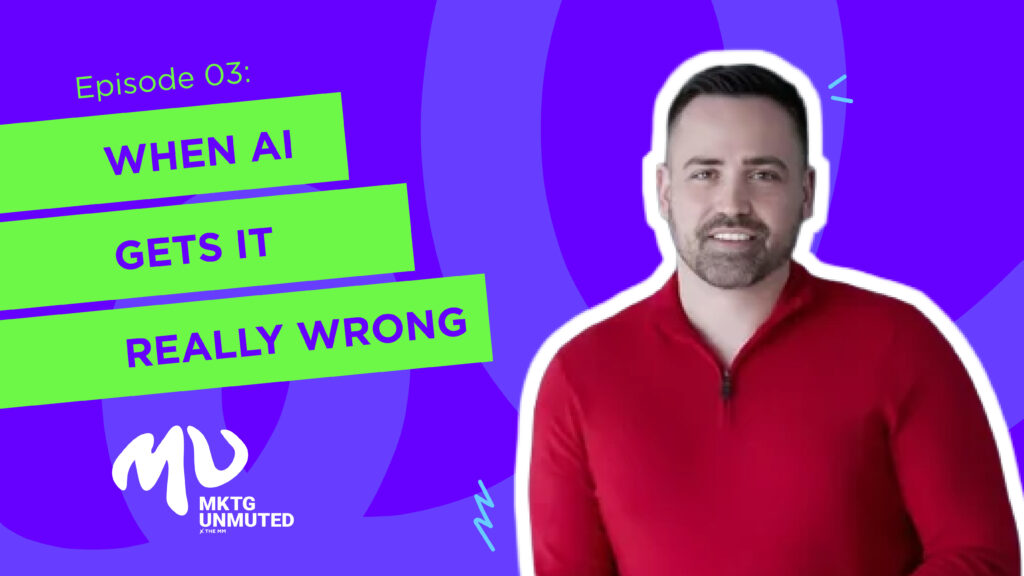
What is AI getting wrong about marketing and search?
Daniel Klein of Joseph Studios joins MKTG Unmuted to break down AI in marketing, AEO vs. GEO, the future of search, and why human context still matters.
We get into how businesses can show up in AI-generated answers, where AI content falls short, why marketing teams need to stay ahead of changing trends, and what business owners should know before relying too heavily on AI.
Then the conversation goes off-script, from difficult clients and agency lessons to bad feedback, unconventional business ideas and why some of the weirdest ideas actually work.
Want to work with Joseph Studios? Request a Quote Here. Follow the on Instagram, Linkedin and Facebook.
Chapters
00:00 AI’s Role in Marketing
03:33 AEO vs. GEO: How AI Search Is Changing SEO
05:30 What AI Search Gets Wrong
06:47 Why Human Context Still Matters
07:20 How Marketers Stay Ahead of Trends
08:30 How Joseph Studios Started
Questions We Answer
What is AEO in marketing?
AEO stands for answer engine optimization and focuses on making information easy for AI-powered search and answer engines to understand and surface.
What is the difference between AEO and GEO?
AEO focuses more on clear, indexable answers, while GEO focuses on the broader context and framework generative AI uses to build responses.
Is AI replacing traditional SEO?
Not exactly. AI search adds another layer to SEO, with overlap across content, PR, social media and other sources AI systems use to understand brands.
Episode Transcript:
Brennah Davis (00:08)
Hey Daniel, I’m super excited you’re here. welcome to my MKTG Unmuted podcast. I was super excited to have you because I know that I’ve done matches with you with the Marketing Matchmaker, and you and I have had many, many conversations about all the different things happening in marketing. And with your company, Joseph Studios, being a full service agency, you have been in the know of everything.
Happening, all the changes. And I know I call you sometimes for advice when there’s things that are changing and connecting you with clients that have awesome crazy questions about marketing. And you know it all. So I was excited to have you talk about marketing and what’s happening.
Daniel (00:47)
Thank you for having me on, Brennah
Brennah Davis (00:49)
Yeah. so one of the biggest things I get questions on with you know, my business is what are the trends with AI, the what’s happening. how people are now searching more than ever with like Chat GPT or Gemini or things like that for information rather than Google. so yeah, I’d love to just hear what’s happening from your end in the marketing world on the AI front.
Daniel (01:14)
There’s a lot of uncertainty, I can tell you that. not just from the marketing teams that we’re talking to and working with, but the business leaders as well. And when my other agency, BrassMonkey Labs, got started and it was in the AI space, there were a lot of clients that were coming to us and asking questions about projects that they had or ideas that they had where they could implement AI into their business. ninety-five percent of those we had to like quietly or politely say, Hey, this
Is going to be woefully expensive. And I don’t know actually if this is going to drive an ROI for you. and that’s kind of been the status quo ever since. That was like what, a year ago? it hasn’t gotten to a point yet where I can tell you definitively from the marketing perspective, there’s ROI in using AI. Every tool that we use, every process that we’ve undergone that uses AI, a human needs to review it. A human has
Has to look at it from the lens of life and reality and the human experience. So we might use AI for like rapid prototyping. Like if we want to just get like five or ten ideas out there just to kind of see what sticks. if we need help kind of understanding what others might have said, AI is a decent tool, but it’s a derivative tool. It takes some knowledge that it has as training data and it
boils it down and condenses it. And quite frankly, it dilutes the value and context in which it exists. it’s not going to come up with anything new. And if you try and come up with new things, it will fervently push back and say, don’t do this. This is crazy. This hasn’t been done. Blah, blah, blah. It’ll say whatever. But in reality, that’s where you hire experts. That’s where you hire someone who has been there, done that syndrome to be able to validate whether or not this is a good idea and know that
AI will not be replacing humans anytime soon.
Brennah Davis (02:58)
Yeah.
Daniel (02:58)
but it’s a good prototyping tool. If you want to slap something together and see what makes sense or just brainstorm with your peers or a client after some revisions, it’ll do the trick. but human intervention and the lens of human experience is still very irreplaceable.
Brennah Davis (03:14)
And how’s it going as far as it being a search engine, right? So like with clients and them wanting to show up, you know, at the top of Google before and now they want to show up at the top of any of these search engines. Well, you know, Chat GPT, Gemini, Claude, how is that going and what does that look like on your end?
Daniel (03:33)
Yeah, so there’s two this is very new. This is as of like October, November 2025. And data recording right now is like June 2026. So we’re still like nine, ten months from this becoming a thing and actually getting titled this, but they call it AEO, answer engine optimization. The alternative is GEO, generative engine optimization. The difference is GEO focuses on like the framework in which the context is built, and AEO is indexable listable answers that could be put into a reply in an LLM. there’s a lot of overlap. And there’s a lot of overlap with SEO. There’s a lot of overlap with public relations. There’s a lot of overlap with social media. these AI agents are using social platforms and press releases and blogs and everything else that SEO uses as training data for these answers. But we’re seeing all these departments that were otherwise independently operating, now needing to collaborate very, very much so, in order for our clients to succeed in the AEO front. but yeah, it does depend on the AI itself. For example, Jim and I will try to produce a balanced answer. And a balanced answer means they have to find something negative. So let’s say for example, your business got a bad review a decade ago.
And it’s the only bad review that you have. The issue is to find that balance, it will dig up that one star review from a decade ago and it will put it at the bottom of the summary. they might have struggled with blah, blah, blah, blah, blah. Or they don’t work well in situations like this. And you’re like, Golly, that a decade ago. so that’s part of the trick is again, AI doesn’t understand context, doesn’t understand the human experience doesn’t understand these types of things. Will it at some point, it depends. it depends on a lot of things that I can’t really account for. But at the moment, this is a pillar within our AEO services that our clients are relying on to make sure that accurate information is displayed, not just all information displayed or balanced information, that kind of stuff.
Brennah Davis (05:30)
Balanced information. I mean, I remember
Daniel (05:32)
Yeah, yeah.
Brennah Davis (05:32)
you telling me that story right probably sometime at the end of last year. And you’re like, I have this client that, you know, we searched them on one of the platforms, and it came up that there was a review on Yelp a decade ago that is showing up as like the negative of their business.
Daniel (05:50)
Yeah.
Brennah Davis (05:51)
And I was like, wow, that’s crazy to think that it’s just pulling data from so long ago.
Daniel (05:57)
Yeah. And so the I guess the rat race is people start to realize this and then they start to distrust the AI summaries and then where do they go to? You know?
Brennah Davis (06:06)
Right.
Daniel (06:07)
you all also bring in the idea that there’s so many bots out on social media that what’s real? And then people start to acknowledge this and it becomes common understanding and then what’s next. So a lot of marketing in the marketing industry right now is asking the question of what’s next, what’s real, how do we
Bring consumers and and sellers together in a way that’s a meaningful kind of human interaction across a digital landscape. Mostly because the sentiment right now is anti-AI. It’s I want to talk to humans, I exist for a reason, I wake up in the morning because I enjoy what I do and I want to continue to do that. So what does that mean for me in the future? And at some level is going to ripple through marketing in a fundamental way where.
We will communicate differently, we will engage with other consumers differently. What does that look like? that’s up for discussion.
Brennah Davis (06:54)
Yeah. How do you stay on top of everything for your business to be the expert in marketing across so many different types of marketing? Because I know you’re a full service agency. I know I’ve matched you for social clients. I’ve matched you for AEO. I’ve matched you for LinkedIn specifically. And so there’s just been other different types of clients that I’ve I know that I’ve matched with your company. And how do you stay up to date with it all?
Daniel (07:21)
Yeah, so I’d say our team is probably nine months ahead of the curve when it comes to trends and understanding what’s going to come down the pipeline. We do that because internally it’s a very free environment to say whatever you need to say. I don’t get chastised for my crazy comments, but the rest of the team also doesn’t. And it’s very helpful when you’re doing research and you have an idea. It puts you in a vulnerable position to send this in front of everyone else in the entire company or multiple companies and say, what do you think about this? or I think this or that. but that’s the culture that we have here. And from that culture, we’re able to share ideas and collaborate or soundboard ideas with each other. see, is this reality? Am I am I going nuts or is this kind of a thing? And that’s the question we’re always asking ourselves. Is this a thing? is this the future or is this an outlier? but lots of news, lots of like looking at things through the lens of someone who’s very cynical. And yeah, that tends to get us about nine months out.
Brennah Davis (08:14)
When you started this agency, I know a little bit of your background, but I’d love to like share with the audience some of your background. Like how did you get to where you are? Cause I know that you kind of just started helping friends and then it just slowly you’re like, this is where I’m going.
Daniel (08:30)
Yeah. So of my peer group, we were all on the same project. It was like a super huge software development project for Pharma. this the culture internally was changing, some leadership changed, we things were going sideways, and we were all kind of at the director level and we’re like, you what, we’re gonna do our own thing. Screw this. And they were starting their own businesses and talking with them and trying to help them from like a project management perspective or a defect mitigation perspective.
They were always having issues with marketing and sales. What do they say? Who do they say it to? How do they get someone to buy that was like the common denominator? I’m like, well, instead of focusing on like process improvement, maybe we just focus on the marketing side, because this is the common questions we keep getting asked, continue to get asked. And that’s where Joseph Studio started. And we’ve been kind of growing like a weed ever since. But it yeah, it started with helping friends get their businesses up and going.
Brennah Davis (09:17)
Yeah, that’s awesome. And then I know you and I have kind of also talked about just other like clients and projects that have I mean, I sometimes I call you and I just I’m like, Hey, is this client fit? And you’re like, Hey, I have had this and you have these awesome stories. Like, what has been the best client that you’ve ever got to work with in a sense? You don’t have to say names, but like what did you do? What did that look like? What was that growth?
Daniel (09:40)
Yeah. man, some names do come to mind. some names seriously come to mind. I would say there’s a very special place in my heart for Neil. There’s a very special place in my heart for Jennifer and her team, and there’s a special place in my heart for Carson and Lisa and a bunch of others. Bunch of bunch of others. I’d say
Brennah Davis (10:00)
Okay.
Daniel (10:01)
every client that we have now.
The exception of everyone. Everyone that we have now, I absolutely love. There’s a very special place in my heart and the whole team’s heart for basically everyone that’s working with us right now. this is our 10 year anniversary month. So we’re celebrating 10 years in business. And we just did like things. Yeah, what a ride, huh? Of all the years to
Brennah Davis (10:15)
Congratulations. That’s huge.
Daniel (10:19)
do business, this is the these are the wild ones. but we did a like a LinkedIn newsletter and at the bottom I flat out said I’m like, I look
To our clients as examples for how to treat other people. Every
Brennah Davis (10:30)
Mm.
Daniel (10:31)
single one of our clients right now is such a wonderful person that they’ve really taught me how to treat other contractors and other people in general. I’m like, hmm, I wonder what this person would do in this situation. And I’m like, I’ll just do that. And it works and it’s great. And everyone gets treated with respect and fairness, and I love it. our clients are absolutely family to us. We love them very much.
Brennah Davis (10:50)
And I know like just being a marketing matchmaker, one of the biggest things I do is education, right? Because there’s so much education with marketing and people will come to me and be like, hey, I want to do this. And then I start digging into like what they’re wanting to do. I’m trying to understand their goals and things like that. And there is, I mean, you kind of get what you pay for in marketing.
I feel like there’s one judgment on marketing that people are scam artists or I’ve had these experiences, I know, where I’ve, you know, heard these awful horror stories of these agencies and people have so much trauma around them that it almost gets hard to work with another one because you’re worried they’re gonna do the same thing, right? And I know that everybody that I’ve matched with you, you’re very good at
Communication, you set really clear guidelines of what the expectations are on both sides. And like I’ve really, really appreciated that. But like I know that there’s had to be so many trials and errors on your end as a marketing agency to get where you are and know how to treat these people, what it’s like to be mistreated. And so I just didn’t know if there’s like any for anyone that’s like thinking about starting an agency or wanting to do is like what are like some biggest lessons learned as an agency working with clients?
Daniel (12:09)
Yes. Look to motivations. Motivations are a really wonderful gauge of whether or not you’re being told the truth. so here’s what I mean by that. Here’s an example. when you are working with a salesperson, understand what their motivations are. Are they paid a salary with no bonus? Are they paid 100% commission and
Brennah Davis (12:27)
Mm-hmm.
Daniel (12:28)
sales are down? Like
How desperate is this person to make a deal? Are they brand new to the team trying to prove themselves? Are they a cynical person with been there done that syndrome? You know, who are they and in what way are they going to make money off of you? And then base your decisions off of that. so from the marketing perspective, I see some of our competitors, which I like none of them, they’ll have sales teams of young, ambitious, good looking, incredibly aggressive salespeople.
Who will tell you anything that you need to hear? they will tell you whatever gets you to push the next button or sign the form or whatever else. If you need to be told that you’re correct, they will say it. If they need to upsell you a website because you’re not sure, they will say it. They will throw anyone under the bus. They will do whatever they have to do. our sales is fundamentally different. You talk to me and we consult together and we see what works, and we put together a plan together and
Then I support you as the team does the work. And I don’t go anywhere. We don’t disappear. I’m alone for the ride. And I deal with the crap that the operations team gives me if something goes sideways. So if I sold the wrong thing or I sold the wrong quantity or I sold something that wasn’t going to be impactful, I’m gonna hear about it from like five other people for the next six months. So to prevent me from having to do that, I will make sure that I sell the right thing to the right person that’s effective.
Brennah Davis (13:46)
Okay.
Daniel (13:47)
Yeah. so there’s another great tool out there called Basecamp and my COO Carly, she’s amazing, told me that their team operates in a circle like it’s like a round robin thing where each person at their company’s does customer support and trouble tickets. And so every single
Brennah Davis (14:03)
Yeah.
Daniel (14:03)
person there has to make sure the product works and the customers are happy because in a couple of weeks it’s gonna be their turn to deal with the tickets that come in because of issues.
So if everyone is having if everyone has the same problem, no one’s gonna have the problem because everyone would have to deal with the repercussions. If you don’t have to deal with it and it, that’s Todd’s issue, he does it, he’ll deal with it, it’s fine. You’re gonna start developing these systematic errors over time.
Brennah Davis (14:27)
Yeah. And I’m sure because of the ticketing system, you’re seeing a lot of things that are happening, probably patterns too, like within marketing as well. Like different hiccups, different things failing, stuff like that.
Daniel (14:39)
Yeah, our clients across different industries. we can see
when something’s working and something’s not working. We can say when Google does an update to their algorithm, we can see how it impacts like eight different industries all at once. we get a really cool perspective in what works for one industry and how it works for another industry and what the similarities and differences are from an architecture standpoint, from like a business operation standpoint. It’s a very cool position to be in.
Brennah Davis (15:01)
Have you had any experience where you kind of predicted you’re like, hey, this is what we’re gonna do marketing-wise, and it went a totally different way, but unexpected and really well. And then maybe the opposite, like, is there have been any situations that you’ve had that just something so unexpected happened with some type of marketing?
Daniel (15:20)
Yeah, so this is happening a lot with AI, going back to
the
AI conversation. two years ago, descriptions for social posts using AI would have been seen as cool and helpful and easy to read. And they were adopted because they were cool and accepted and easy to read. And now if you see a dog on M-dash, you’re like, no, skip. And then you’re done. Right. if you say, it’s not this, it’s that. It’s nope, done, scroll. so
You really gotta stay ahead of the curve with what’s boring and what’s nauseating from a content perspective. And if it looks
Brennah Davis (15:49)
Yeah.
Daniel (15:50)
like everything else and it doesn’t make sense and it’s not jiving, then it’s not gonna work. So being an advocate to the team and saying, This is what’s happening, this is what we’re seeing, this is what the future’s gonna look like, and then communicating that to the client and like, I know you like this, but we don’t want to do it anymore because it’s not going to be effective and keeping those conversations going, that’s super important.
That’d probably be the most
Brennah Davis (16:09)
yeah.
Daniel (16:10)
relevant, probably most timely kind of advice.
Brennah Davis (16:12)
Yeah, I remember I went to art school and during typography learning about the en dash, em dash, all that in typography, I loved using it when I designed my own books, And now I cringe.
it’s like ruined the art of typography.
Daniel (16:26)
Yeah. But that’s how it goes.
Brennah Davis (16:29)
I know, I know.
Daniel (16:30)
When AI first came
out, we couldn’t even speak in proper English because everyone would accuse us of using AI. I’m like, no, he has an English degree. He better be doing this. Yeah.
Brennah Davis (16:38)
Yeah. And how important is it now that it’s not AI content? is that a thing?
Daniel (16:46)
People still want
to reach out and talk to other humans, you know? If I were an AI agent and this were all fake, that would feel different. that wouldn’t be a lot of fun. people don’t always want to feel validated and they want a little bit of pushback, but they want to be a part of a community. Otherwise they’d be off on a mountain, some hermit somewhere living under a tree. I don’t think that’s going away.
I don’t think that’s gonna change and there’s gonna be some sort of pushback. You’ll see these huge pendulum swings in society. you know, where there for a while everyone was going nuts from one perspective and then the pendulum started swinging back, and now we’re kind of on the opposite end of that spectrum as a society, and then it’s gonna start swinging back the other direction too. so as crazy as things get, you can expect it to be crazy but in reverse in about a year.
Brennah Davis (17:27)
Yeah. I get frustrated when I get put through an automated system on a phone and never get to a human.
Daniel (17:33)
Yeah. If if if you don’t value my time, why should I value yours?
Brennah Davis (17:37)
in a predictive sense, how much of this people using AI content, you know, there’s some business owners that won’t hire an agency and they’re just like, No, no, no, I’ll just have chat GPT, write my blogs.
Like how much of that is going to maybe affect the businesses down the road? Because there’s like rumors that it’s gonna be a problem.
Daniel (17:54)
Yeah, it already is.
Brennah Davis (17:55)
it’s actually to cause more harm than good.
Daniel (17:57)
Yeah, so AI blogs and AI content do not get indexed.
Brennah Davis (18:01)
Mm.
Daniel (18:02)
they just don’t get indexed. So there’s not gonna be any SEO value in those blogs, they just don’t get indexed. And the reason is not because Google and Yahoo and Bing and all these others don’t like AI content because they have AI agents themselves, it’s because it’s derivative. And so they’re using everything as training data. These crawl bots are also hitting your blogs. And if you’re using like a copy of a copy or a derivative of a derivative of a derivative.
Then your AI agents themselves become such a echo chamber of the exact same thing that it breaks. so they don’t index AI content. what does that leave? It leaves a human. And then a human shows up and sees AI content, they see the em dashes, they see it’s not this and that, and they go, Well, they didn’t put a lot of time or effort into this web page. Clearly, they don’t put time or effort into communicating to clients. The expectation then is if I become a client of theirs.
I’m gonna have very little time or effort dedicated to me and my needs. Maybe I go
Brennah Davis (18:53)
Mm.
Daniel (18:53)
look for someone who actually can perform at a higher level. And then they do.
Brennah Davis (18:57)
Yeah, that makes perfect sense. Has there ever been just like a client that pushed you guys kind of out of your box or comfort zone in terms of marketing that you were surprised about but loved?
Daniel (19:09)
Hmm, hated? Could I swap hate loved for hated? yeah.
Brennah Davis (19:12)
yeah, sure. Or hate it.
Daniel (19:15)
We’ll slip some piping hot tea together. so gosh.
Brennah Davis (19:18)
Well
Daniel (19:19)
There have been these like we keep talking about trends. And
Brennah Davis (19:22)
Mm-hmm.
Daniel (19:22)
if you recall back, I think it was like 2019, 2020, there was like the CBD Delta 9 trend. And
Brennah Davis (19:27)
yeah.
Daniel (19:28)
there was also a trend of like everything had to be AF, right? Everything was AF, everything was AF. And he was like, I want this to be AF.
My golly, I hate you so much. Geez. so we took on a client because why not? and they bought the Twitter account for an account that already was established. It had like 400,000 followers. It was called Tweakers Tweaking. And it were it was just yeah, it’s exactly what you think it is. it was just videos of people tweaking out in Walmart parking lots. And
That’s the whole thing. And they decided to purchase this Instagram channel for like 50 grand or something, rebrand it for their company, which was a CBD company, and then start publishing the instant audience, instant community, and then just start publishing the social posts that we were creating. I remember the email I sent to them. I was like, do not do this. And if you do this, we will not help you and we will not deal with any of the consequences of you doing this. Like very transparent.
Brennah Davis (20:19)
Yeah.
Daniel (20:20)
Like
I think this is a terrible idea. What do you what are doing? Long story short, he lost like 80% of his followers, and everyone else went absolutely psycho on him. And like, we loved tweakers tweaking. You’ve ruined it for us. My day is completely screwed, and I hate your company. And it was like that for like six months. I’ll never be in a situation where I go to a client and go, told you so, but like.
There was a lot of heavy sighing on that call.
Brennah Davis (20:41)
that.
they’re just so polar opposite. I guess people just have these ideas and they think they’ll work, but
Daniel (20:46)
Yeah, every once in a while you’ll come across someone who’s never had a difficult day. Everything was handed to him on a silver platter or it just kind of fell into their lap. There was one entrepreneur way back in the day. You remember the whole metal straw trend because of that turtle with the straw up his nose? Remember that? Yeah.
Brennah Davis (21:00)
Yes. Yes.
Daniel (21:02)
He had a metal straw company in South California. And everything I told him, all the like structural things of how to set up a growing, prosperous company in marketing and sales and everything else.
Flat out rejected because why would he accept any advice? Because everything he’s ever done worked out. He has a metal straw company in his parents’ garage. He makes lots of money selling metal straws. He doesn’t need anything or anyone’s advice. And then like six months later, the trend was over and he was kaput.
so yeah, you on occasion meet someone who’s never had a difficult day. What do you tell
Brennah Davis (21:31)
Yeah, I get hesitant even matching people that have never worked with agencies, you know. I’m like, ooh.
Daniel (21:35)
I could see that.
Brennah Davis (21:36)
I only because like they’ve never experienced and understood what it’s like and how in depth marketing is, right? they don’t understand how much work goes behind like what can’t just take a photo and post it?
Daniel (21:50)
Yeah, working with others is
hard. Yeah. It takes practice.
Brennah Davis (21:55)
or they’re like, well my nephew, I’m like, then have your nephew. come back
Daniel (21:58)
Yep.
Brennah Davis (21:59)
after your nephew does it and we can talk. Let me know how that goes. Let me let you experience that. So then you have a deeper appreciation and respect for the industry. I’ve had people that have come to me with The Marketing Matchmakers looking to be match and never had marketing before. And
They end up hiring their niece, nephew, neighbor, cousin, whoever, friends, daughter. And it’s usually about three months and they’re back and they’re like, Hey. I’m like, what happened? They’re like, they did it for about a week. Or it never got done.
Daniel (22:33)
And then they got bored. There’s very low barriers to entry in this this field.
A mechanic can wake up tomorrow and say, I’m gonna be a social media manager, and nothing’s gonna stop them, except experience.
Brennah Davis (22:44)
Yeah. it’s been something I’ve experienced especially with like the newer business owners, new entrepreneurs. yeah.
Daniel (22:50)
We call them junior entrepreneurs. Hard
charged and ready to go at the base of a mountain. Gonna make it happen.
Brennah Davis (22:55)
Yeah.
Daniel (22:57)
And we’ve all been there.
Brennah Davis (22:58)
yeah. And I mean, it’s all just lessons learned. I know when I had an agency back in the day, I had someone on my team that would just say yes to everything. And
Daniel (23:08)
Mm-hmm.
Brennah Davis (23:08)
that taught me so much. Like there’s just a phase of our agency where it’s just like, no was never an answer.
Daniel (23:15)
Mm-hmm.
Brennah Davis (23:16)
And the amount of times that I just remember being like, What are we gonna do? Why’d you say yes to this? We’ll figure it out.
Daniel (23:23)
It’s great to have teammates that do that, but you gotta put in controls. We have a project management office. so it’s not asking the person, Hey, can you do this? Get with the project manager and they schedule it and it’s part of a pipeline and it’s you know, size to make sure that they don’t go over if they won’t want to, that kind of stuff. But yeah, it’s yeah.
Brennah Davis (23:39)
Yeah.
But I mean, I just remember part of my learning curve with being an agency was just, you know, something that ate at me when I had was a part of that company, right? Like was just I felt like I wasn’t respecting the clients and giving them. And so I remember just even inner even interviewing you and knowing that you say no at times.
And so like I appreciate and respect that of your agency is like, yeah, we don’t do that. Cool. Thank you for telling me.
Daniel (24:07)
Yeah. Yeah.
Sa we’ll save ourselves a couple of emails later.
Brennah Davis (24:12)
Well, yeah, and the heartache of clients, right? Like it’s so important to be so transparent. And one of the other things I loved about working with you is how like when we’ve done pitches, you’ve always said like I look at the data and we pivot as needed, right? Especially
Daniel (24:26)
I don’t know.
Brennah Davis (24:27)
when it comes to like ad campaigns, things like that. You just like I look at social campaigns, I look at the data and then see what’s happening and then we pivot accordingly because you know, why waste anyone’s time and money?
Daniel (24:38)
Things change too quick these days, too. I having
Brennah Davis (24:40)
Yeah.
Daniel (24:41)
a hard and fast plan in place, it just it’s not gonna work. personally, I will start moving forward with a forty percent plan. If you got forty percent
Brennah Davis (24:48)
Okay.
Daniel (24:48)
of a plan, you know enough of the plan that you can start actually execution. And then you can figure the rest out as sizes or metrics or numbers or people or situations change. Because they will.
Brennah Davis (24:58)
Right, because you’ll have actually actual data to be looking at. When you start there’s nothing there. And I think that that’s something that a lot of early business owners don’t understand. They’re like, Well, I wanna know how you know. And it’s like, Well, I won’t know until we start.
Daniel (25:12)
So if there’s any listeners that are in that spot and they’re like, I want to know for a fact this is gonna work before I hire anyone, my advice would be, my brutal advice would be this might not be the best venture for you. This is a super high risk adventure. Being a business owner carries a 95% chance of failure in the first five years. And there’s a lot of money at stake when you start a company. I mean, even like the easy companies to start, it’s gonna be like 50 grand to get that company
Off the ground. So it might not be the best venture for you, just putting that out there. But for the right soul who loves punishment and agony, who wakes up in the morning anxious, ready to make the sale or help out a customer. And if you are insanely passionate about what you do, this might be the thing. You might very fervently enjoy this. but that’s what it takes. that’s literally what it takes. I would advise this person.
Sell to your friends and your family. If you can’t sell something to your friends and family, it’s probably not a thing. And if they have questions or changes or implications, have that as part of your sales process. If you can sell it to ten of your friends and family, you can sell it to ten people you don’t know. And if you can sell something to ten people that you don’t know, you can sell it to the world. And that’s a thing.
Brennah Davis (26:17)
Yeah, I think there’s advice I’ve been given before is like have someone that’s like a cheerleader in your corner, but also have somebody that like really pushes back with you in your corner, like somebody that will argue with you and challenge you because you need that. I approached a photographer and was like, Hey, I really love what you do. I’d love to put you in my rotation, add you to my Rolodex of agencies. And he was like, No.
And I don’t know anyone that would work with you.
I left really upset, but the lesson was learned that I just didn’t pitch my value was not brought to that conversation. It’s nice to have those people that push back. If your family’s pushing back, it can help you either readjust, realign what you need to do, branding-wise, communication-wise, all the things.
Daniel (26:59)
Yes, I would also caveat with pushing back doesn’t mean saying no. And you don’t want to have a bunch of distractors. So there’s some blurry, super blurry line between saying no, this is a bad idea, you’re gonna hurt yourself and others, or challenging them to think through all the implications of that decision and then finding out for themselves whether or not they would be happy with the result. Like the Socratic method, but for
Brennah Davis (27:22)
Mm. I think.
Daniel (27:24)
like coaching and mentorship. So if you were gonna say, I want to start a business, I would say, that’s fantastic. What can we do today to start the business? And
Brennah Davis (27:32)
Mm-hmm.
Daniel (27:33)
if you start saying, I don’t know, or you know, I have no idea. It’s just a thought. I’m like, okay, cool. So if we’re in fantasy land and we’re just chit chatting, cool. but challenging you might mean challenging you to come up with the details of what you want to do so that you can start actually getting it done. And in doing that, I can help you realize your dreams, right?
Brennah Davis (27:49)
Yeah, mm-hmm.
Daniel (27:50)
But I don’t say no as I do that. And if you come across a roadblock, you’re like, I can’t overcome this roadblock or I’m not comfortable doing this, you’re like, okay, well, then we could just back off and not do this. That’s fine. But you came to that conclusion. I didn’t force it on you.
Brennah Davis (28:01)
Right. That was a lesson learned for me. My communication, my pitch. Cause he was the first person to ever say no to me. No one ever had said no.
Daniel (28:08)
That was kind of brutal.
Brennah Davis (28:09)
Up until him. I we’re really good friends.
Daniel (28:12)
Okay, okay. Maybe that’s brutality. Okay.
Brennah Davis (28:14)
we are part of a business group together, and we’ve had conversations about that. And he was like, I didn’t realize how brutal I was. I was like, Yeah, you were pretty rough, and he’s like, I’m sorry. That was a tough pill for me to swallow, but it did push me. It pushed me for better delivery,
Maybe I wasn’t clear in my pitch. Like I didn’t bring enough value.
So I look any time of those moments, I try to see them as opportunities of growth. How can I be doing better if someone says no? Is there a reason? It might be a them reason, not a me reason, but if it’s a me reason, how do I fix it?
Daniel (28:45)
True and I just wanna acknowledge that sometimes it sucks to get beaten up so much. Yeah. Feedback is a gift and it’s nice to not get beaten up all the time.
Brennah Davis (28:54)
Yeah, that’s fair. But yeah, I absolutely love, love, love helping businesses find the right agencies. And it has just been so amazing connecting with so many awesome agencies and getting so many cool pitches and learning how they got there, right? And everybody’s story and building their agency is so different. And same with the businesses.
yeah, sure.
Daniel (29:17)
Can I ask you a question?
How many times do you match a customer with some agencies and all the agencies are saying the exact same thing versus someone or one agency does something completely out of the field?
Brennah Davis (29:33)
I will say for every client that I match, and as far as like what the deliverables are, they’re pretty similar, but the knowledge from each agency is very different. So when we go into the pitches,
I’ll give an example. I had a client who was a former attorney, and now she like wrote a book
She wanted to sell this book online. And on one side of it was she wanted to run ads. Like that was how she saw it. But each agency had a different route of what that looked like. And all of it was ads, but it was done differently. And she and I met after I reviewed the proposals. I was like, these are all just different types of marketing for your book. One of them was very influencer.
ad marketing. One was very social driven, as far as like running ads on Instagram, stuff like that. And the other one was as far as the influencers were concerned, it was having the influencers do it. And then there was a side of it that was doing like TikTok shop. so it was very interesting to just kind of get a really wide range of ways of doing ads for this book because it was a product.
not a business.
so it was just a little bit differently. But she had such knowledge that it had to be a lot of education about her first. because this was like new for her. So I think that sometimes I do get a lot of different ways to go about it. It’s usually what the person feels most comfortable with. And then I have had some
Occasionally I will throw in a curveball myself. So I might have two agencies that are very similar in approach, pricing, everything. And I will throw in a curveball of I have an agency that does VA. You work with them, they will train your VA to do all of your marketing in-house, but also be your personal assistant.
And so depending on what it is, I might throw that one in as a curveball. If they’re talking about like, you know, I think I might hire a VA for this or that, and I hear some of these keywords, then I will throw that curveball in.
they were an agency before they were a PR company. And the owner, it was two owners, they split ways. One became a PR company, one of them
started hiring VAs for themselves to help run their agency and they realized how valuable that was. And so they created a whole training platform for these VAs. So now they basically help you hire a marketing assistant. So it wouldn’t be like a strategist. they’d be more of a technician versus a strategist.
Daniel (32:02)
I think that’s
a natural progression of things. You start with your cousin or your niece or nephew or neighbor or someone from church. And then you progress up to VA with multiple disciplines, but you have to constantly make sure that they’re productive. And then you graduate to your first agency after.
Brennah Davis (32:17)
Well, and so this VA company, the way that they work is they have a whole platform where all the VAs connect with one another. They all have marketing backgrounds, these VAs do, and they can connect with each other. And if one of them has questions, they can talk to each other. But the agency trains them all and they’re all like set on that same baseline of what is expected of them in their marketing role. And then part of their job, they’re basically a full time employee, these VAs are. they’re also an executive assistant.
So they help you with scheduling emails, whatever you really need help with, they train them to be two roles, which for
some businesses is very valuable. Other businesses they don’t need that. So sometimes I throw that curveball in. Kind of just depends
on the person.
Daniel (33:00)
did the lawyer ever start selling her book?
Brennah Davis (33:03)
she had some things that she needed to go through on her book side of stuff. So she had to put a pause for a while on things and she had a great idea about what she wanted to go do moving forward. But since then a lot of things have changed.
Daniel (33:18)
That’s right. Yeah.
Brennah Davis (33:19)
And so the match needs to be rematched at some point whenever she’s ready. and it was kind of one of those things that she had a friend working on the website, and I don’t know when that website will be done.
I don’t know how high of a priority versus her other side of her business is,
Daniel (33:33)
That’s fair.
Brennah Davis (33:34)
you know, because the book’s not her full business, it’s just a way of marketing.
Daniel (33:38)
Having multiple revenue streams is a survival technique these days.
Brennah Davis (33:42)
Yeah. So if it’s not the one train that’s leading you where you need to go, then
Yeah. So but no, that was a great
Daniel (33:47)
Yeah.
Brennah Davis (33:48)
question. I do love getting really unique businesses that are kind of full service in a way. just because they’re kind of rare.
Daniel (33:56)
Yeah. So sometimes people like will come with crazy ideas and they’ll expect me to judge them on their crazy ideas. And when I don’t, I feel like they think I’m just trying to sell them. and like, why is this guy not judging me on this insane idea? I’m like, I’m not judging you because I’ve seen some insane ideas work. Right? Who am I to judge you on your idea? I’ve seen some
Crazy things absolutely work. I’ve seen some really good ideas with poor execution not work at all.
Brennah Davis (34:20)
Yeah.
Daniel (34:21)
if you actually don’t have a product or you can’t help with customer support, that’s a short path. But people come up with insane ideas. And I’m like, all right, go for it, cool. That’ll work. Why not? Let’s give it shot. I’ll I’ll
Brennah Davis (34:31)
Yeah.
Daniel (34:32)
set up the structures correctly, I’ll make sure the targeting’s done correctly, we’ll find out who your ideal consumer is, we’ll market to them. the rest is up to you. But yeah, people.
There’s no reason to judge people on their ideas.
Brennah Davis (34:42)
No, I don’t think so at all, especially in we’re in such a creative field.
Daniel (34:46)
Yeah.
Brennah Davis (34:47)
For me, like when someone has a really wild hair of an idea, I’m just like, you know what? I wanna see this happen for you.
Daniel (34:55)
Yeah. Yeah. I want to go on this adventure. There was one time
Brennah Davis (34:58)
Mm-hmm.
Daniel (34:58)
I think I did pause. I think we did get one
Brennah Davis (35:00)
An adventure.
Daniel (35:01)
Yeah, there was one time we paused on an adventure because we’re like, I don’t know, this is this is a little bit too crazy. Too too crazy. And we’ve seen some crazy stuff. This one was a pill you wanna hear about it or no? We can move on to the next question.
Brennah Davis (35:13)
Yeah,
we have like about five minutes.
Daniel (35:16)
That’s fine.
So anyway, just for funsies at the end of this, it was a foreign company that was trying to make it in America. And I’m like, cool, that happens all the time. America, I still to this day think is one of the best economies you can try and push your market into or push a product into. Anyway, this one was a pill that you swallowed that vibrated inside of you to relieve constipation.
Brennah Davis (35:35)
Wow.
Daniel (35:36)
Yeah. And the part I couldn’t figure out is why it came with a charging port.
Brennah Davis (35:40)
Okay.
Daniel (35:40)
Yeah. And so I’m like, that’s a great You wanna do what?
Brennah Davis (35:44)
Where is it, still exist?
Daniel (35:46)
I don’t know. I love checking in on past prospects and seeing how they’re doing, but this one I haven’t gotten around to in a while. But yeah, I was like, man, why does it have a charging port? Do you charge it before or do you swallow this thing twice? Do you flush a lithium battery down the toilet? What what is this?
Brennah Davis (36:01)
Yeah.
Daniel (36:01)
Anyway, they didn’t end up moving forward and we’re grateful for that.
Brennah Davis (36:05)
wow. Okay. Yeah.
Daniel (36:06)
But it’s still a cool story. I mean it’s got some more stories.
Brennah Davis (36:09)
Hmm. I mean, love it. Love the story.
Daniel (36:12)
There are no crazy ideas, but that one was a little bit crazy.
Brennah Davis (36:15)
I mean there are crazy ideas, but you know, I love hearing And no judgment for them.
Daniel (36:20)
Yep. The world’s a big place.
Brennah Davis (36:22)
Well,
Daniel, thank you so much for taking time to meet with me and just talk about marketing and be a part of this. I love sending clients your way. I know that you’ve taken such great care of them. And yeah, that’s part of the reason I want to have you on here is ’cause I know that you know what you’re doing.
Daniel (36:37)
Thank you very much. I appreciate that. And happy to help.
Brennah Davis (36:38)
Yeah, of
course. Yes, absolutely. And yeah, I look forward to many more matches.
Daniel (36:44)
Always.
Brennah Davis (36:44)
All right. Thanks, Daniel.